

By Vitaliy Katsenelson
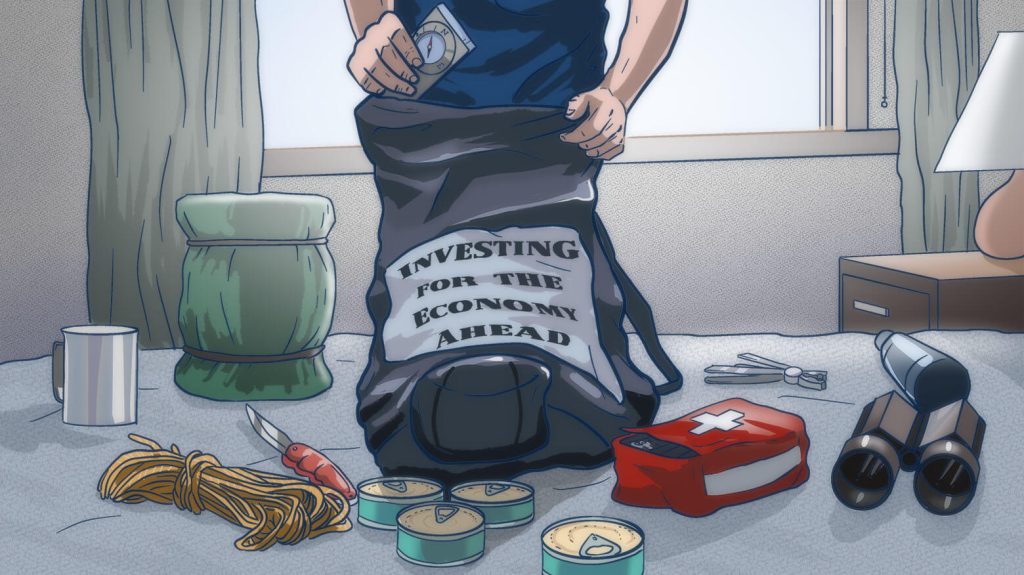
(Artwork by my father Naum Katsenelson)
I’ve received so many emails about the WSJ front page article in which the Russian expert, a professor and ex-KGB agent predicts that the US will falter and be split up into five zones (see map below, here is a link to the original article and here is a link to his video interview) and each zone will be controlled by another country like China, Canada, Mexico, and EU. Alaska would go to its “rightful” (more like wishful) owner – Russia. You get the gist. I could not contain myself, I had to respond with a letter to Mr. Ex-KBG.
Continue Reading January 5th, 2009

By Vitaliy N. Katsenelson, CFA
A basic property of religion is that the believer takes a leap of faith: to believe without expecting proof. Often you find this characteristic of religion in other, more unexpected places–like the stock market.
It takes a while for a company to develop a “religious” following: Only a few high-quality, well-respected companies with long track records ever become worshipped by millions of investors. The stock has to make a lot of shareholders happy for a long period of time to form this psychological link.
The stories (which are often true) of relatives or friends buying a few hundred shares of the company and becoming millionaires have to percolate a while for a stock to become a religion. Little by little, the past success of the company turns into an absolute and eternal truth. Investor belief becomes set: The past success paints a clear picture of the future.
Gradually, investors turn from cautious shareholders into loud cheerleaders. Management is praised as visionary. The stock becomes a one-decision stock: buy. This euphoria is not created overnight. It takes a long time to build it, and a lot of healthy pessimists have to become converted into believers before a stock becomes a “religion.”
Religion stocks are held on faith. The traditional analysis is rarely applied, as it is perceived that these companies operate in a different gravitational field and that the laws that drive the valuations of the rest of the market are suspended when it comes to them. Take General Electric. Until recently, it was perceived as an infallible, can-do-nothing-wrong corporate icon. Its shares were passed from generation to generation with a whisper: “Never sell GE.”
However, once the religious, unconditional, in-GE-we-trust veil was lifted, many found it to be just another complex, un-analyzable financial conglomerate that is suffering from addiction to the commercial paper market. There is nothing new I can really say about GE except that it represents what is wrong with religion stocks–it is bought (and actually in most cases held) on faith. Few attempted to value it beyond looking at reported ruler-like earnings that were played like a fiddle by management by manipulating pension plan assumptions and shifts in reserves in opaque GE finance.
Today’s discussion is not about GE but about another religion stock that is about to get its religious veil stripped. I have to warn you, it is another infallible corporate icon that can do nothing wrong: Exxon Mobil–the biggest (nongovernment-owned) oil company in the world, the $400 billion market cap gorilla that brought wealth to generations of people.
What is wrong with Exxon? On the surface, very little. It has $25 billion of net cash (cash less debt); it grew revenues and earnings on per share basis at 16.5% and 25%, respectively, over the last five years; it pays a decent dividend of 2.1%; and the stock is a true bellwether, as it is down only 15% year-to-date, when the market is down at least double that. Here is the best part: It trades at only nine times estimated 2008 earnings of $8.75 per share.
Wait a second, this does sound like a perfect stock! This type of superficial, on the surface analysis is only granted to religious stocks. Their long-term track and an aura of reverence establish the leap of faith that eases us into drawing straight lines from the past into the future, and this is very dangerous.
Arguably, a similar “religious” attitude created by a consistent 12% a year, ruler-like performance and a blue chip pedigree ( as a founder of Nasdaq) allowed Bernard Madoff to lower the guard of even very sophisticated investors and deprive them of billions.
If you were to take off the religious veil from Exxon and look under the surface, you’ll find quite a different story. The incredible double-digit revenue and earnings growth came completely from the big rise in oil and natural gas prices. XOM spent close to $90 billion finding new oil and natural gas, but oil reserves have not increased at all. Gas reserves are up 25% since 2003, but gas production increased very little.
I invite you to spend some time with XOM’s annual report. You’ll find that volumes of production and reserves in all its segments have not moved much since 2003. In many cases, they declined. So the magic behind all that growth over the last five years had little to do with XOM’s operating performance but was totally driven by commodity prices and share buybacks.
You might say that XOM is at only nine times earnings, and there’s not much growth built into the stock. Keep in mind, however, that XOM only trades at that valuation if it can earn what it earned in 2008 when oil prices were between $85 and $150. Unfortunately for XOM, fortunately for rest of us, oil prices are making five-year lows, revisiting the mid-30s.
My motto in life that I borrowed from Keynes is “I’d rather be vaguely right than precisely wrong.” Let’s figure what XOM’s vaguely right valuation is.
Exxon’s earnings overstate its true earnings power. To estimate XOM’s earning power at today’s prices, let’s look what it made when oil prices were in the 30s and 40s. In 2003 and 2004, when oil prices averaged $28 and $38, XOM made about $3 and $4 a share, respectively. Since XOM’s reserves are not growing, it is reasonable to expect no growth of production in the future. Don’t deceive yourself: XOM is just an operationally leveraged proxy for oil (and natural gas).
If oil stays where it is today XOM will not earn $8.75, as the Street expects it to earn in 2008. Is earnings will be around $3 or $4. It is trading at 20 to 25 times these earnings. This is a very high valuation for today’s environment, where companies with similarly strong balance sheets, with pricing power (XOM is a price taker), and whose cash flows are increasingly independent of what commodities are doing (non-cyclical) pay higher dividend yields and trade 10 or 12 times true earnings. Yes, there is a 50% downside in XOM’s stock.
My crystal ball on oil prices is as good as the next guy’s, but it is reasonable to expect that demand for oil will only be declining while the global economy is in a recession that only started in earnest a couple of months ago. Also, despite OPEC’s “production cuts,” the economies of its members are one-trick-ponies–they export petro chemicals and import everything else. As their oil revenues collapse, despite their threats, they cannot afford to produce less oil, and they have to keep building those golden palaces in the desert. So demand is declining, and supply may actually rise.
Let’s call today’s $30-$40 oil the seminormal case, though it could get worse. But what if oil prices go to $150? It is an unlikely scenario, at least while the global economy is in a recession, but in this case XOM has an upside of about 20%, as this summer it traded in the 90s when oil went to $147.
Exxon may be a great company. It made a lot of investors happy, but its success is in the past–it is simply too big to grow and it can barely find enough oil to replenish its reserves. Probably not in the very distant future its reserves will start declining–over 90% of oil reserves are owned by foreign governments, and they are not really looking forward to parting with them. Investors who own Exxon are gambling on oil and natural gas prices, and the odds are stacked against them: tails (high probability) you are down 50%, heads (low probability) you are up 20%. Even Vegas slot machines have better odds.
Emotions have no place in investing. Faith, love, hate and disgust should be left for other aspects of our life. More often than not, emotions guide us to do the opposite of what we need to do to be successful. Investors need to be agnostic toward “religion stocks.” The comfort and false sense of certainty that those stocks bring to the portfolio come at a huge cost: prolonged underperformance.
P.S. There are couple additional but important caveats to XOM’s valuation: XOM bought almost a quarter of its shares since 2004, thus if XOM were to make the same income today as it did 2004 for its EPS would higher (net income divided by lower share count gives you higher EPS). Second, costs have increased substantially: cost of finding new oil doubled from 2003 and getting oil out of the ground up 40% from 2003. These two factors cancel out each other.
Another point on valuation: XOM’s capital expenditures exceeds it depreciation expense thus on free cash flows – a true determinate of company’s worth, is lower than net income by about 30%. For the simplicity of the analysis, I used P/E with unadjusted E, but you really need to adjust your E down to reflect lower free cash flows.
Vitaliy N. Katsenelson, CFA, is director of research at Investment Management Associates in Denver, and he teaches a graduate investment class at the University of Colorado at Denver. He is the author of Active Value Investing: Making Money in Range-Bound Markets (Wiley 2007).
If you would like to receive my articles by email (usually couple days before I post them to this website), drop me a line (click here).
January 4th, 2009

By Vitaliy Katsenelson
(Artwork by my father Naum Katsenelson)
I spent some time on the phone with a journalist discussing my thoughts on Russia and a story of my family coming to the US from Russia in 1991. Playing a devil’s advocate he would say – “yes, things are bad in Russia but look at the US?” He’d repeat that question time after time.
This made me realize how important it is to have an appropriate frame of reference when we evaluate things. Yes, things in the US will get worse in the near future, especially if your frame of reference is the recent past, late 90s and 2000s (especially 2000s). I cannot argue with that. We spent money we did not have and now it is payback time. A number of companies were socialized by our government. So how are we different from Russia then?
The difference is night and day. The US did not do it for Robin Hood(ian) reasons. It is simply playing the role of lender of last resort. This may prove to be a right or a wrong move, only time will tell. But the US government is reluctant to socialize its private sector, and will de-socialize its stakes in private enterprises as soon as it can. In fact, it has embedded incentives for financial companies that issued preferred stock to the US government to buy it back or at least refinance it within five years, as the preferred dividend rate jumps from 5% to 9%. We are not Russia where permanent socialization is taking place.
We may have to drive the same cars for a longer time, watch TV on a 42 inch TV set instead of 64 inch, or god forbid eat out less. Most of us don’t have to worry about being able to put food on the table. My kids (my son is 7 and my daughter turned 3 a couple of days ago) were both born in this country and will not have my frame of reference from growing up in Russia – I am thankful for that. But at the same time it is my responsibility as a parent to instill a proper frame of reference in them. They don’t know how lucky they are to be growing up here. I am planning to watch Pursuit of Happyness with my son (my daughter is too young) a terrific movie starring Will Smith that will hopefully make him appreciate what he has a bit more.
Even at our worst we don’t have to fear repercussions of being critical of our government or president. We cannot be told by our government what we can or cannot write. In August I wrote a fairly critical article of Russia and war in Georgia. I never submitted the article to be published. I was going to visit Russia in September and simply did not want to take the risk. I know I am a very small fish and read by only 20 people (on a good day). Call me a coward, but even a very remote risk of being persecuted for my thoughts while I was visiting Russia did not appeal to me. We have many freedoms that we simply don’t appreciate, because fortunately (and I mean fortunately) we have a different frame of reference. We’ve had freedom of speech in this country for a long time and unlike Russia we are not looking at nationwide unrest, dictatorship and loss of personal freedom.
Today’s conversation with the journalist brought up another sad memory of growing up in Russia. I was eight, my mother took me to sign up for chorus. The teacher was filling out an application/questionnaire. One of the questions was “what is your nationality”. I said I was Jewish. But I vividly remember guilt and shame when I said it. I did not know why, but I knew something was wrong with me being Jewish. That was an anti-Semitism in Russia for you. A freedom of being who you are is another freedom that we take for granted.
Despite this being quite a very difficult year, there are many things we should be thankful for, we just need a different frame of reference.
Wishing you a very Happy New Year!
If you would like to receive my articles by email (usually couple days before I post them to this website), drop me a line (click here).
December 31st, 2008

By Vitaliy Katsenelson
(Artwork by my father: Naum Katsenelson)
Russia’s economy is deteriorating at a very fast pace. The Stabilization fund - a giant $450 billion savings account - has been depleted by a quarter since September as Russia tried to defend its currency. Despite that attempt, the ruble still declined.
Russian companies are facing $170 billion of debt rollover next year. Since the rest of the world is not willing to finance companies in stable political regime, getting financing for Russian companies will be a problem (times have changed). Mr. Medvedev and his boss (Mr. Putin) will have to spend another quarter of the reserve to fund Russian corporations. According to FT as the Russian economy is staring into a deep abyss and Russians suddenly start waking up to realization that almighty Mrs. Oil and Mr. Natural Gas were responsible for (the temporary) resurrection of Mother Russia, and not Mr. Putin, people are already whispering for Mr. Putin’s resignation.
These whispers will magnify as things get worse. But what concerns me is the likely response. I visited Russia in September for the first time since I left in 1991, and even though at the time Russia was still prospering (and economic crisis was weeks away) I still felt this broad anti-American attitude. Now that things are getting worse every minute, Mr. Putin will likely redirect the attention and shift the blame to - you guessed it - the United of States, the mother of all evil. The United States will be responsible for the global crisis, for manipulating oil markets, and anything bad that happens in Russia, the US will be the culprit. I don’t think this brings the US to war with Russia, but the relationship with Russia will likely get a lot worse.
December 29th, 2008
By Vitaliy N. Katsenelson, CFA
(Artwork by my father Naum Katsenleson)
I often start my mornings with egg, cheese and turkey sandwich at Panera Bread. This morning was no different. While reading newspapers on my Kindle, sipping hazelnut coffee (I know I just lost respect of the true coffee drinkers), I started with yesterday’s FT, an article on China piqued my interest. China plays a very important role in the global economy and thus I pay close attention to it. I started reading:
“The benchmark one-year lending rate was cut by 27 basis points to 5.31 per cent, while the one-year deposit rate was lowered by the same amount to 2.25 per cent.”
This is not surprising news, but shows originality - China doesn’t want to be like the US, thus it cuts interest rates in multiple of 27 basis points, not boring 25 basis points.
“The government estimates more than 10m migrant workers have lost their jobs so far, while 6.5m university students will enter the workforce next year.”
China is unlikely to escape the fate of developed countries, it faces rising unemployment. This raises a question – will it lead to political unrest? High unemployment in China is very different than high unemployment in the US or Europe. Unlike in the developed world, there is not much of a social net in China. In the US if you lose a job, you may be forced to shop at Wal-Mart instead of Target and you have to downgrade to basic cable – only 50 channels, sorry. I am oversimplifying, but we got unemployment benefits and many other government programs that will not allow one to starve. That is not the case in China, its safety net is in infancy, therefore high unemployment may mean hunger for many and political unrest. Chinese government knows this well. Unless it comes up with social net very quickly, it will stimulate the hell out of its economy that goes far beyond the stimulus it announced - this means more government spending. (I hear that the previously announced stimulus was just a reshuffle of normal government spending.) The next news makes things even more difficult:
“Chinese exports collapsed in November, contracting 2.2 per cent year on year after seven years of double-digit growth, while industrial output growth slowed to 5.4 per cent from 8.2 per cent in October.”
Though economists still forecast 5% GDP growth next year in China, above statistics put that forecast in doubt. But even if 5% GDP growth forecast is right, as I’ve discussed in the past, due to the unique nature of Chinese economy (it has tremendous operational and financial leverage) it can only function in two modes – forward and backward, there is little middle ground. At the low growth speeds, and 5% is low for China, the manufacturing part of the economy simply chokes up and starts losing money. Thus the following news makes a lot of sense and simply scary:
“China’s foreign exchange reserves, the largest in the world, apparently fell in October for the first time in five years, according to an official from the State Administration of Foreign Exchange.” [emphasis added]
Published economic numbers are very likely not describing a true economic reality in China. Despite economic growth, for the first time in a long time, China feels a need to dip into its piggy bank – foreign reserves. But here is a scary part – that piggy bank is mostly in the US dollars. The US Government is printing a lot of money at the moment to deal with our own problems, printing press may not be inflationary in the short-run (although definitely inflationary in the long-run) as velocity of money is declining – banks are barely lending and consumers are deleveraging and are reluctant to borrow. But if Chinese economy continues to deteriorate – a likely scenario as the deterioration just started – Chinese government will stop buying US Treasuries and even worse it will start digging into its US reserves. Since there are no other natural buyers (in size) of the US debt our interest rates may actually skyrocket, the US dollar drops against Chinese currency, while our inflation may still remain low. This is bad for China twice:
- High interest rates means even lower economic growth from the US and thus even lower consumption of Chinese made goods.
- China cannot afford weak US dollar – its US dollar reserves are worth less and more importantly its product becomes more expensive for the US consumers.
Here is another thought: all this is taking place while long-term government bonds at the lowest rates ever (or close). Long-term US Government bonds are likely the most overpriced asset in the world, period!
If you would like to receive my articles by email (usually couple days before I post them to this website), drop me a line (click here).
December 26th, 2008
Vitaliy Katsenelson – Forbes.com
In crazy times like today, all one could and actually should ask for is sanity. Yes, sanity–a clear mind free of noise to deal with the insanity that is thrust upon us by a volatile and noise-making machine also known as the stock market. We find ourselves glued to the computer screens or CNBC waiting to find out what the Dow’s next tick is going to be. Unfortunately, we are left with only a headache and wasted time. OK, what’s next?
Here is my advice–read. Read books that will bring you sanity, the ones that will snap you back into the shell of investor and out of the sorry shell of nervous observer of the daily stock market melodrama. The following books are excellent choices and will come with plenty of sanity and sage advice.
Continue Reading December 21st, 2008
Vitaliy N. Katsenelson - Forbes

Bad decisions when times were fat spell a rough road ahead for those who hold their savings in Russian currency.
It is amazing how things change in a few months. In September, Russia was on top of the world, the returning global power. Today, it is slipping into obscurity. If it did not have nuclear weapons, most would not even care what happens.
Russian economic growth in this decade was completely driven by rising commodity prices, mainly of oil and gas. As the global economy goes into recession and commodity prices either decline or remain at today’s levels, Russia will relive the horrible 1990s when it defaulted on its debt and suffered from a severe inflation. Think of Russia as a very large oil and gas producing company that is run for the most part by a government that makes General Motors’ (nyse: GM - news - people ) and Ford’s (nyse: F - news - people ) management and autoworkers’ unions look like progressive thinkers.
Over the last five years, Russia de-privatized (a clever euphemism for “stole”) oil assets from private investors and has been milking petro cash flows from now state-owned oil companies. The government is simply not equipped to manage projects that have a multidecade life. Russia underinvested in exploration and development of oil and gas in the last decade and that is why its oil and gas production is declining.
Communism failed for a reason: Government is a horrible capital allocator. The time horizon and time in office of a government bureaucrat is much shorter than the horizon of an oil company, therefore when choosing between drilling holes in the middle of nowhere that will increase oil production years down the road or raising benefits to retirees, retirees win.
But it gets worse. As oil prices rose, the Russian government decided that it did not need the West anymore. It felt that the contracts it signed with BP (nyse: BP - news - people ) and Royal Dutch Shell (nyse: RDSA - news - people ) in the 1990s–when oil prices were much, much lower and no one wanted to invest in Russia–were not advantageous anymore. Using deceptive legal practices, it unilaterally renegotiated those contracts muscling away lucrative projects from these companies.
It is just amazing how things changed in six months. Declining oil prices will likely force Russia to come back to foreign investors begging for investment, but this time it will not receive it. Would you blame them?
Yes, it gets even worse. The return on capital in oil and commodity-related industries was much higher than in any other industry. This siphoned capital from other industries, which caused investments in these industries to decline. The rise of commodity exports drove up the Russian currency, making noncommodity industries even less competitive in the world market. Once you take high commodity prices away, Russia is worse off than it was before.
On top of this, when Russia did well, it acceded to pressures to increase social programs. While the revenues were flowing, Russia paid off its foreign debts and created a Stabilization Fund, a multihundred-billion dollar savings account. But it is hard to say how long this fund will last as Russia spent (wasted) $57.5 billion on defending the ruble in September.
Russia is strong on a balance sheet basis, but that is a reflection of the past. The future, as reflected in its future income statements, looks horrible. To some degree it is almost a mirror image of the U.S.; our balance sheet is weaker but our earnings power is strong. Despite all the problems we have in the U.S., we have the most diversified economy in the world. Unfortunately, that is not the case with Russia.
The Russian currency will decline substantially over the next several years as Russia will try to print itself out of the problem. Despite the intervention, the ruble already declined close to 20% versus the U.S. dollar since July, but the decline has only started. Money is leaving Russia, which is why the ruble is collapsing.
Construction projects big or small came to a halt in September and October. People took their money and ran. I called my childhood friends in Russia last month and advised them to move their ruble denominated savings out of ruble into dollars and/or euros (either should be better than the ruble), preferably also taking their savings out of Russian banks and either transferring into big European banks or just putting them into a safety deposit box.
Yes, unfortunately, I believe the Russian ruble will collapse.
Vitaliy N. Katsenelson, CFA, is director of research at Investment Management Associates in Denver, Colo., and he teaches a graduate investment class at the University of Colorado at Denver. He is the author of “Active Value Investing: Making Money in Range-Bound Markets” (Wiley 2007).
If you would like to receive my articles by email (usually couple days before I post them to this website), drop me a line (click here).
December 17th, 2008
By Vitaliy N. Katsenelson, CFA
When I think of the Jos. A. Bank (JOSB), I think of Yogi Berra’s saying “Nobody goes there because it is too crowded.”
Only in the case of JOSB, it sounds like this: “EVERYBODY goes there because it is NOT crowded.” As most men who shop there will attest, you are lucky to see and handful of customers shop at there at once at any given time. Nevertheless, it seems that JOSB operates in a very different economy and there is an incredible disconnect between its performance this year and the rest of the economy as well as other retailers.
JOSB reported 3rd quarter numbers couple of days ago and they were stellar even by a healthy economy’s standards.
They were truly incredible considering that negative double-digit same-store sales for retailers have become the norm. JOSB reported same store sales of 7% for the quarter (the company doesn’t report monthly numbers anymore). Total sales were up 13.7%. Operating profits before taxes were up 20.3%. Cash was up year-over-year, and inventory growth lagged sales. Every single metric was simply beautiful.
A great number of the company’s stores were opened over the last three years which puts them in the category of “immature.” New stores, almost by definition, generate lower sales than mature stores. As stores mature, same store sales rise and profit margins expand. In addition, the company is able to spread advertising dollars against a large store base, which is another reason why the margins increased.
By the year-end JOSB should have over $100 mln of cash, which is about a quarter of its market cap. The margin expansion may actually continue into next year. JOSB said that it will slow down store openings next year but it will increase offerings of big and tall merchandise. I believe this will help JOSB generate more free cash flow as well as drive (a much higher margin) same store sales. At some point the economy will catch up with this retailer, but a lot of internal positives I just mentioned should mitigate the external negatives.
I presented JOSB at Value Investing Congress in Pasadena this year (see slide 31 and on).
We DON’T have a position in the stock, we sold out in September.
December 5th, 2008

By Vitaliy N. Katsenelson, CFA
“You should buy Freeport McMoRan (FCX), Caterpillar (CAT), PACCAR (PCAR).” - that is what I hear from friends of mine, who are in the biz, all the time. They tell me how cheap these stocks are - 3, 6, 8 times earnings. “You are a value guy! How come you are not loading up on them?” they say.
Let me tell you when I’ll buy “stuff” stocks (if ever do buy them because I’ve never really cared for the cyclicality of their business). It’s when everyone stops telling me how cheap they are and that they are “buys.”
These stocks are very similar to housing stocks two years ago: housing stocks were down 50% and looked cheap. Value managers bought just to see their stocks get cut in half again and again.
One needs to sub-normalize earnings in this environment for all stocks, but “stuff” stocks need to see their earnings to be “sub-sub-sub-sub normalized.” I’ve said it before, but it is worth repeating: the global economy just started its journey of going into a recession; demand for “stuff” will drop off the cliff most likely to a lot greater degree than anyone imagines.
I hear from my friends in Russia that the construction business that was booming only in September is dead. Like deader than dead. It doesn’t matter if projects were finished or not, investors took their money and ran. Russia may appear like a special case since its prosperity is directly linked to commodity prices, but the slowdown is happening in the rest of the developing world like China and India… and the list goes on.
Stuff stocks are likely to bottom when they’ll look expensive - their “E’s” will be low or negative. Also, consumers were not the only ones that over-consumed “stuff.” Emerging markets over-consumed earthmovers, tractors and factories. They still have huge overcapacity at a time when the global economy is slowing down.
Have a very happy and safe Thanksgiving!
If you would like to receive my articles by email (usually couple days before I post them to this website), drop me a line (click here).
November 25th, 2008
By Vitaliy N. Katsenelson, CFA
I wrote this article almost two years ago, it is by far the most important article I ever wrote. I strongly encourage you to read it today. Successful investing is about following a successful, time-proven process in good and bad times (especially bad times). Of course, the problem with the process - though it may work in the long run, in the short-turn it may produce rather painful results. In today’s environment, sticking to the process by identifying great companies – the ones with strong balance sheets, wide moats, great management, conservatively valuing them (not forgetting to sub-normalize their earnings/cash flows) and buying them at a significant discount to their worth, has produced slightly better results than if you were to buy overpriced junk. But that is the short-run. Cyclical bear markets teach us to do the opposite of what we should be doing: they teach us to love cash – at the wrong time, they reward sell decisions as it raises cash and they keep punishing every buy decision we make.
I wanted to share with you an interesting anecdote. My partner, who is 30 years my senior, worked for a mutual fund company in the 1970s. His firm used a market timing service that got them out of the market in 1973 – they sold stocks and were in cash. The market declined over 40% in 1974. Victory! – right? Well, the market timing service did not get them back in on time and they missed the bulk of the 60% rise in the market in 1975.
Timing the market is very difficult because you have to get two things right at once: the economy and the emotions of the market’s participants. Good luck! For instance, even if you were brilliant and predicted that the subprime crisis will unfold in the summer of 2007 (though it could have happened in late 2006 or early 2008) the market did not care and went up 25% and made an all time high. Value individual stocks, don’t time the market – that is the only process that for most investors has proven to work in the long run. Thus we’ll be sticking to our process.
If you would like to receive my articles by email (usually couple days before I post them to this website), drop me a line (click here).
November 21st, 2008
Vitaliy N. Katsenelson - Forbes
Government intervention in the financial system via the Troubled Asset Relief Program made me sick to my stomach, but without it, there is a real possibility that our economy would have come to a screeching halt as trust in the financial system was strained to the point of breaking. Confidence among depositors and banks alike needed to be restored.
The putative bailout of Detroit’s “Big Three” automakers is quite different from TARP, as it will only postpone the inevitable. No matter how much money you throw at them, the Big Three, or at least General Motors, will most likely still go bankrupt. They have managed to lose billions in good times and bad times.
Their business models were broken before the financial crisis hit; the crisis just accelerated the inevitable. The only questions are how soon and how much of the taxpayer’s money they’ll consume before they face their fate, since they have structural problems that will not be resolved until they go bankrupt.
Continue Reading November 19th, 2008
I had a fun radio/podcast interview today with Chuck Jaffe at MarketWatch (here is a link, my portion of the interview starts on the 10:40 mark), we “played” hold it or fold it with some of the stocks we own: American Express, eBAY, Nokia; stocks I would NOT want to own: GE, Goldman Sachs, Bank of America, and Citigroup. And as always I did not miss an opportunity to upset the gold bugs (I’ve written about gold before here and here).
November 19th, 2008
I was quoted in this week’s Barron’s on AmEx (AXP):
“This company can weather a huge hurricane and come out fine,” says Vitaliy Katsenelson, head of research at Investment Management Associates in Denver. “American Express is one the simplest financial companies to analyze. It’s much more transparent than Citigroup or JPMorgan or Goldman Sachs.
He argues that the government safety net removes a key risk with AmEx: funding. AmEx has relied on commercial paper and on securitization of credit-card loans, two markets that are difficult now to access. AmEx says it’s comfortable about its ability to refinance some $24 billion in debt maturing in the next year.
November 16th, 2008
I’ve said for a long time that one should not trust economic statistics data coming from the Chinese Government as it has the incentives (and power) to interrogate the data until it confesses to what it wants to see. Today we learned that industrial production in China rose 8.2% in October, a slowdown from 11.4% growth in September, and falling below expectations of 10.8%. So even though industrial production growth was not great, it was still growth and a fairly decent growth by the “developed” world standard. But there was another bit of news (in the same article) that really bothered me - volume of electricity generation dropped 4% in October - yes, it was a drop. So which number would you trust?
Maybe it is the pessimist in me, or maybe I’ve written so many “China will slowdown articles” that I am looking for data confirming my view (the confirmation bias) - that is possible, I am human after all. Or maybe I have a hard time imagining industrial production rising in high single digits while electricity generated declined during the same time period.
China may have some country specific innuendos that I may be missing being thousands of miles away, but unless proven otherwise I’d believe in decline not growth in the Chinese economy, especially when all the other numbers show decline as well: car inventories are at four year highs, real estate market (both commercial and residential) are overbuilt, government is coming up with a $600 billion stimulus package, unemployment is rising, demand from the developed world has slowed down etc…
November 16th, 2008
AmEx becoming a bank holding company (BHC) is not just net positive for the company it is simply positive. When a highly leveraged investment bank like Goldman Sachs turns into a BHC, its future profitability suffers as its leverage drops to commensurate level of the bank. Lower leverage leads to lower profitability. AmEx on another hand, though not regulated by the Fed, maintained a capital structure very similar to a bank - it securitized its credit card portfolios and market participants demanded bank-like leverage ratios. AmEx’s profitability will not be altered by becoming a BHC – so no negative here.But here is a very significant positive - it will be able to borrow from the Fed, paying a puny 1-1.5% to fund its credit card portfolio. AmEx becoming a BHC removed a liquidity risk – a risk that AmEx will not be able to fund float and provide credit in its credit portfolio. Fed funds and discount rates will not stay at these levels forever but an increase in the rate will coincide with an improved economy and stabilized credit markets and thus AmEx will not need the Fed anymore.
I did a fairly in-depth analysis of AmEx in March 2008, though many things have changed since the thesis has not changed that much.
November 12th, 2008
Vitaliy N. Katsenelson 11.05.08, 7:00 PM ET - Forbes
Whenever I write or speak in front of a group of people and feel the need to apologize for my message, I am usually right. This usually happens for two reasons.
First, I am likely saying what people don’t want to hear; and second, because the message goes contrary to common opinion. So I am probably right about what I am about to say, as I am getting this tingly “don’t shoot the messenger, please” feeling while I am typing this: The global slowdown (and the key word here is ‘global’) is just starting and will last longer than most expect.
Until just a few months ago, the slowdown was taking place in the developed world: the U.S. and Europe. The developing world (China, India, Russia and Latin America) appeared to be marching to a different economic drummer. Those countries appeared be insulated from their biggest customers’ economic problems in the developed world. Suddenly in September, developing economies were not tone deaf anymore and started to march to the beat of the developed world’s drum and their economies joined up with the rest of the developed world and embarked on the decline.
Developing economies had an incredible decade of growth, but this growth is behind them, not in front of them, at least for awhile. An unstoppable growth train, mighty China, is derailing. The Chinese purchasing managers’ index fell from 47.7 points to 45.2 points in October, the steepest monthly fall and the lowest point since the index was started in 2004. Meanwhile, a government-backed survey of manufacturers dropped 6.6 points to 44.6 in October, also a record fall.
How much trust would I put in these numbers? Not very much as they are reported by a communist government, in a country where the expression “don’t shoot the messenger” has a different and more literal meaning. Anecdotal evidence from Chinese companies or companies doing business in China bears a lot more weight than government statistics that will likely lag reality by months (if not longer).
Continue Reading November 10th, 2008
I was interviewed by terrific Robert Huebscher at Advisor Perspectives. We’ve revisited my range-bound markets thesis, possible economic scenarios for our economy, and discussed global economy including Europe, Russia, Middle East, and of course China. Here is a link to the interview.
Robert also interviewed me awhile back, we discussed range-bound thesis in great detail. Here is a link to the interview
If you would like to receive my articles by email (usually couple days before I post them to this website), drop me a line (click here).
November 4th, 2008
I wrote an article in February 2007 in the Rocky Mountain News called - “You are not as smart as you think” (see second article) that article was written to address overconfidence that we get in bull markets. Today I’ve slightly rewritten the same article to address underconfidence of bear markets.
You are not as dumb as you think - or - Psychotherapy for Bear Markets
Lately I’ve been getting this nagging feeling that everything I touch turns to dirt. Every time I buy a stock that is already down a lot, the one that my analysis leads me to believe is cheaper than dirt, it declines more. Did I completely lose my ability to value stocks? Did I start ignoring Will Rogers’ advice? Buy stocks that go up, and if they don’t go up, don’t buy them.
No, I didn’t get much dumber, and my stock picking skills haven’t diminished that much over the past year. I was simply a willing participant in the latest (cyclical) bear market. Bear markets make you feel dumber than you are, the same way a bull markets make you feel smarter than you are. Feeling dumb makes you do the opposite of what you should be doing. Fear and pain - yes, continued losses cause a lot of pain - are dangerous things because they can make you (and me) panic, lose confidence and do the opposite of what we should be doing. To alleviate pain we sell, we react, we default to the only asset that made us money (so far) in the bear market – cash! Cash is only a king when other assets are princes. When you cannot find a stock with a long-term (a key word) superior risk reward profile, then cash is King (with capital “K”). However, during a cyclical bear market, cash is slowly demoted to a prince as great companies are thrown out the window with the junky ones. You have to actively make yourself aware of the eight-letter word T-O-M-O-R-R-O-W! Yes, tomorrow. Think of the lyrics from Annie:
When I’m stuck with the day that’s gray and lonely
I just stick out my chin and grin and say, ohhh
The sun will come out, tomorrow
So you gotta hang on’ til tomorrow
Of course, we don’t know if tomorrow is tomorrow or years from now. But investing is a marathon, not a sprint, and do not let the bear market turn you into a sprinter.
First of all, remind yourself that you are not as dumb as your portfolio makes you feel. You have bought a stock (once or twice) that made you money. This is what I do. I pull out a chart of a stock on which I made a boatload of money or one I sold (for the right reasons) before it declined. I do this with pleasure, trying to relive my “smart days”.
We all have these stocks, the ones we nailed. We tend to forget about them during the bear market phase. But I suggest you remember them now, when you feel lonely and miserable, so you’ll have more of these names to remember in the future as cash will not bring the pleasure of victory in the long-run. The cyclical bull market is still there; it is just hiding under the ugly sentiment of the cyclical bear market. Believe me, it will show its happy face. It is just a matter of time.
In a bear market, it is easy to forget about buying. Selling is a much easier decision to make. Every time you buy a stock you look dumb because it usually goes down afterward. I recently bought a couple of incredibly cheap stocks and, of course, they declined. I don’t feel smart about these buys right now. However, awhile back I analyzed these companies, figured out what they are worth, determined an appropriate margin of safety and got my buy prices. Stocks declined, fundamentals have not changed, so I bought these stocks.
You cannot worry about marking the “bottom” in every buy. My objective is not to buy at the “bottom” and sell at the “top.” No, my objective is to buy a great company when it is cheap and to sell it when it is fairly valued! I suggest you do the same. Will Roger’s advice is great, but unfortunately I am yet to meet a human being who has figured out how to apply it in real life. No, you are not as dumb as bear markets make you feel.
You are not as smart as you think - or - Psychotherapy for Bull Markets
Lately I’ve been getting this powerful feeling that everything I touch turns to gold. Every time I buy a stock, it goes up. Did I finally figure out the stock market game? Did I find a secret to Will Rogers’ advice? Buy stocks that go up, and if they don’t go up, don’t buy them.
No, I didn’t get much smarter, and my stock picking skills haven’t improved that much over the past year. I was simply a willing participant in the latest (cyclical) bull market. A bull market makes you feel smarter than you are the same way a bear market makes you feel dumber than you are. Feeling smart makes you do the opposite of what you should be doing. The euphoria of the golden touch is a dangerous thing because it can make you (and me) careless. We forget about risk since we haven’t seen it in a while and focus only on our rewards. You have to actively make yourself aware of the four-letter word R-I-S-K!
How do you do that? My favorite way is to remind myself how “dumb” I am. I pull out an annual return report of a company on which I lost a boatload of money and masochistically try to read it from cover to cover, reliving my “dumbness.”
We all have these stocks, the ones we lost a lot of money in because we were overconfident. We tend to forget about them during the bull market phase. But I suggest you remember them now, so you’ll have fewer of those names to remember in the future. Risk is still there; it is just hiding under the joyful sentiment of the bull market. Believe me, it will show its ugly face. It is just a matter of time.
In the bull market, it is easy to forget about selling discipline and then turn into a “buy and forget to sell” investor. Every time you sell a stock you look dumb because it usually goes up afterward. I recently sold Becton Dickinson (BDX) at about $72-$73, and then it hit $78! I don’t feel smart about that decision. However, when I bought Becton Dickinson, I set a sell P/E, and when it approached I quickly reviewed the stock’s fundamentals - they had not changed much, so I sold the stock.
You cannot worry about marking the “top” in every sell. My objective is not to buy at the “bottom” and sell at the “top.” No, my objective is to buy a great company when it is cheap and to sell it when it is fairly valued! I suggest you do the same.
If you would like to receive my articles by email (usually couple days before I post them to this website), drop me a line (clicke here).
October 23rd, 2008

I was interviewed by Forbes in early October. I discussed my favorite “dotcom” portfolio of stocks, here is a link to the video.
October 13th, 2008
Some thoughts about the market. In today’s market you see some unbelievable opportunities. For the first time, in a long, long time, we can actually put a full portfolio together where we don’t have to compromise on Quality, Valuation or Growth (QVG) when we pick stocks (please, please, please NOT! a solicitation). Until recently we had a large cash balance as we could not find enough stocks that met all the QVG criteria. So, on the positive side, it is a stock picking heaven for value investors. On the negative side, unless you had cash going into this debacle you have to sell one declined stock to buy another that has declined more.
I was quoted this weekend in Rocky Mountain News and Denver Post.
In the Rocky Mountain News article that discusses mark-to-market accounting, I suggest a “compromise”. My “compromise” was to put both market-to-market and mark-to-model disclosures in footnotes. This may not help the banks as according to current rules they’d still have to mark down their assets to mark-to-market. But my understanding is that insurance companies are regulated on state level and many states do allow the mark-to-model treatment. The truth is somewhere in the middle but maybe this would shore up investors’ confidence and make analysis somewhat easier.
If you would like to receive my articles by email (usually couple days before I post them to this website), drop me a line (clicke here).
October 13th, 2008
I was interviewed by The Wall Street Transcript, here are some excerpts from the interview:
Investing vs. speculating
Let’s talk about financial stocks for a second, because I’m sure they are on investors’ minds right now. You want to be an investor rather than a speculator; at least I am talking about investing. If you own financial stocks, you want to make sure that you own the ones that you can analyze. I dare anybody to analyze Citigroup (C) or Bank of America (BAC). Those stocks could be cheap and they may end up having great returns, but most generalists, including myself, can’t analyze those companies; they are too complex. If you are buying a company whose fair value you can determine, you can analyze and access risk and required margin of safety – you are investing. If you’re buying a company because it’s declined a lot and has a good reputation, and you think it’s going to go up but can’t fully determine how much it’s worth (or can barely analyze it), you are speculating. I encourage to only own financial stocks that you can analyze. Take American Express (AXP)– it is a credit card company and processing company that you can actually sit down, look through the financial statements and figure out how much it’s worth – it is analyzable. That’s just one example of that.
Here is a very detailed analysis of American Express I completed in April (PDF).
Profit margins, profit margins, and profit margins
Another point, and this is where I spend a lot of time right now: when you look at companies you want to make sure that you normalize their profit margins. For a lot of companies, especially “stuff” stocks that have very high margins, you have to look at where they were historically, you have to look at their business and say what would happen if the global economy slowed down. (Though I believe the slowdown is a question of when, not if.) Would they be able to maintain these high margins? If not, you have to figure out their normal margin over a long-term cycle and value them that way. This way you’re going to avoid buying a lot of companies that see their margins contract and sudden, like housing stocks, go from 10 times earnings to 50 times earnings overnight.
On selling
Even if you don’t want to become an active value investor, you should at least become a buy and sell investor. Selling is like a four letter word in a bull market. Investing is about buying and selling; even long-term investments are about buying and selling. You want to buy companies when they are undervalued, and when they get fairly valued you want to sell them. If you don’t sell them, you’re just going to see their PE keep contracting and contracting. So you want to be an active investor, a buy and sell investor. Also realize this: return for any company or any stock really comes from three sources: dividends, earnings growth and P/E contraction or expansion. If you consider a stock that you are sure will continue to pay dividends and grow earnings, ask yourself a question: is it going to see PE contraction or expansion?
If you buy a company that is undervalued and whose P/E is undervalued and you receive dividends while you hold it and you receive return from earnings growth, and P/E goes from low to relatively normalized, guess what? You’ve already captured one source of return that may not be there in the future, the P/E expansion. Initially all you’re going to get is dividends and earnings growth. The sell question remains - “Is this company’s growth rate and dividend going to be high enough to justify holding the stock?” If the answer is yes, keep holding it. If the answer is no, move on to a different stock. Exercise “sell” discipline. Once P/E is normalized (increased) is not your friend, not anymore – the margin of safety is gone.
A stock idea
There is this little company that nobody ever heard of, Microsoft (MSFT). I’d tell you there are so many reasons to hate Microsoft. Their Vista product is a flop (at least there is a perception that it is a flop), Google (GOOG) is coming out with a new competing browser, the company’s too big, nobody understood what their Seinfeld and Gates advertisements were about. So the stock is hated. I used Vista and hated it, at least at first; they have improved it since. By the way, think about the kind of competitive advantage the company must have to sell 160 million copies of Vista, a failed product. Imagine what would happen if they actually had a successful product! This company has a tremendous competitive advantage.
Google is coming out with a new browser, and it may possibly hurt Microsoft’s search and advertisement businesses. However, Microsoft is losing money in its advertising business, in its online business. These businesses are not priced into the stock, they actually detract from its earnings and valuation. Even if Microsoft gives up and shuts them down, it should only be a positive. My point is, Microsoft may lose the war with Google on advertising (and that’s very possible), but it’s almost irrelevant. This is a company that’s trading at about 12 times earnings. If you take out cash, which they have $20 billion of, it’s trading at 11 times earnings.
There is another argument that Microsoft cannot grow at a very fast rate. In the last quarter they grew their earnings and sales in the mid-teens. How many companies do you know that actually can trade at 11 times, 12 times earnings; have returned capital in the mid-30s; have a competitive position that no other company in the world can match; have grown earnings in mid teens; and are trading at that valuation. But it gets better. When you value Microsoft, even if you take their earnings growth rates to zero, the stock is still too cheap. If I’m wrong on the growth rate and they say they’re going to start growing at 6% to 8% a year, even at that point the company still will be too cheap. In this economic environment, where you want to own very strong companies with bulletproof balance sheets, this is a perfect stock. And yes, I do own it – as do my clients.
October 5th, 2008

This weekend’s papers provided new signs of global economic slowdown. The first came from Japan. For the first time in 26 years – a long time – Japan became a net importer (imports exceeded exports). FT article sums it up:
- The contraction was led by plunging sales of Japanese cars and trucks in a weak US automobile market. Exports to Europe also declined while growth in shipments to China and other Asian countries – including sales of Japanese factory equipment used in those countries’ own export industries – slowed sharply.
Note that deceleration in growth in demand from “unstoppable” China. As you can see from this FT article – a demand for steel started to decline in China – a second sign.
- Indian iron ore exporters on Monday warned that demand from steel mills in China had fallen sharply over the past month and that Chinese buyers were defaulting on contracts with suppliers.
Could the Japanese slowdown in sales of cars be driven solely by high oil prices? Could Chinese decline in demand for steel be driven by post Olympian (short-term) slump? I suppose. But in the past neither country had to make an excuse. The probabilities have just increased that we are facing worldwide economic slowdown. That may not be a bad thing. We need things to cool down and normalize. But if you think the “stuff” stocks (energy, materials and industrials) are “growth” stocks that are just taking a breather before they embark on a continuation of the run we saw over last four years, think again.
I hope the following two articles will explain why I think that may not be the case.
Look to the margins when using the price/earnings ratio
Chinese and Starbucks Late Stage Growth Obesity
If you would like to receive my articles by email (usually couple days before I post them to this website), drop me a line (clicke here).
September 29th, 2008
I am sorry, I could not contain myself. I got a call today from a financial journalist asking me if gold is “the” asset for the doomsday portfolio. I took this question very seriously after all if you are reading the news we are on the brink of one. I weighted my words very carefully. And answered: No! You need to diversify into canned food and guns. I added, as I learned by watching the TV-show Jericho - salt is the ultimate commodity you should own:
- “Salt has more applications than virtually any other mineral. Besides being a dietary necessity, salt can be used as a preservative, an antiseptic, a dentifrice, a cleanser, an abrasive, a fire-retardant, a defroster and a deodorizer. The list goes on and on.”
-
- The problem with gold is that it is very hard to determine its worth. It is only worth something if market participants perceive it is worth something. Unlike bonds or stocks, it is not a cash flow producing asset thus traditional valuation metrics cannot tell you if it is cheap or expensive. You look at Microsoft, you may disagree on the assumptions that you put into the discounted cash flow model, but it is worth somewhere between $20 and $50. It is analyzable. Gold is only worth something if people consider it to be a store of value – the doomsday currency. But if it lets people down even once, it is done! Here is what I wrote about gold in my book.
If you would like to receive my articles by email (usually couple days before I post them to this website), drop me a line (clicke here).
September 26th, 2008
MarketWatch - September 25, 2008
By Vitaliy N. Katsenelson, CFA

“Don’t worry they’ll bail them out.” Those words are jumping off my tongue couple times a day now when my clients call and ask if I think their auto insurance policy with AIG or their money market fund will be around tomorrow or their CDs will be made whole if FDIC goes bankrupt. Though I love putting my clients at ease, there are consequences to the bailout:
- Inflation. At some point the government will not be able to afford to keep bailing out our financial (and other, real) companies and will have to start printing presses to keep affording it. Though it is hard to have inflation while the financial industry is deleveraging, when credit normalizes, we will be hit with massive inflation.
- Weaker dollar. Give me a just one-armed economist, demanded President Truman. I feel his pain. This is how I feel when I talk about the US dollar. Only last week I thought the odds were that the US dollar will embark on the appreciation journey against other currencies. After the bailout announcement the prospects are lot less clear. The US government possibly starting a gigantic printing press is not good for the greenback. However, currency strength/weakness is driven by relative economic performance not absolute. This where “the other hand” comes in, maybe foreign governments’ printing press will be even bigger than ours? We don’t know. So prepare for both.
- Higher interest rates. In the past we did not have to worry about the financial strength of the US government, but today the government’s financial strength has been tested. Though I doubt it will happen, I would not be surprised if Microsoft’s new AAA rated bonds will have a lower yield than US Treasuries.
- Higher taxes. On the bright side, the bailout may or may not end up being a bailout. If the government were to buy loans 30 cents on the dollar and if they were worth at least a 30 cents, then the government is providing liquidity - the cost to taxpayers is zero. Not necessarily a bailout. But there is a reason why there is a liquidity problem - the market is not really sure what those 30 cents on the dollar loans are really worth. Derivative securities that derive value from other derivative securities - so called derivatives squared - are very hard to value. Unfortunately, the government is not better equipped to value those loans than the market, though it does have a longer time horizon to discover what they are worth. In other words, Mr. and Mrs. Taxpayer are buying a cat in the bag and hoping it’s not a rat when we open the bag a year or two from now. If it is a rat, our tax bill will start climbing.
- Moral hazard. Of course, there is also an issue of moral hazard that Mr. Paulson created when he insured money market funds. Usually the difference between performance of the best and the worst market fund is 10-15 basis points. So if you ran a money market fund why wouldn’t you be loading on the riskiest highest yielding paper (within the allowed parameters) you could get your hands on? You’d just make sure it matures in less than a year (this is when the government put runs out). There is only upside and no downside. If the risky bet pays off, the fund manager will make a load of money for fund holders and get a nice juicy bonus. If the bet goes wrong, well, you still made a decent amount of money, fund holders will not lose money and Mr. Taxpayer will bail the fund out. There is another possible unintended consequence of this action — companies that previously were not able to issue commercial paper will be able to. In fact the government’s actions made all commercial AAA rated, after all now it is backed by the full faith and credit of the US government. Now I only wish stock investors the same opportunity, we’d be buying warrants on penny stocks.
Unfortunately, the cost of not bailing out maybe even higher.
Mr. Paulson, a common sense and free market fellow, not a tea leaf reading academic, was never a proponent of government bailouts. He must have seen the consequences of financial freeze starting to spill into the real economy. Over $130 billion in assets were withdrawn from money market funds when Reserve fund “broke a buck,” declined 3% below par.
Why does it matter? Money market funds buy commercial paper issued by corporate America. If credit worthy companies (overnight) cannot issue commercial paper to finance their day-to-day operations (inventories, suppliers, employees etc.) the “real” economy will be disrupted.
At that point the cost of the bailout will have a lot more zeros in it.
Vitaliy N. Katsenelson, CFA, is director of research at Investment Management Associates in Denver, Colo., and he teaches a graduate investment class at the University of Colorado at Denver. He is the author of Active Value Investing: Making Money in Range-Bound Markets (Wiley 2007).
If you would like to receive my articles by email (usually couple days before I post them to this website), drop me a line (clicke here).
September 26th, 2008

Forbes.com - September 6, 2008
By Vitaliy N. Katsenelson, CFA
“Don’t gamble. Take all your savings and buy some good stock and hold it till it goes up, then sell it. If it doesn’t go up, don’t buy it.”
What if you failed to follow that sage advice from Will Rogers? You bought a stock and it did the unthinkable–it declines.
Real world investors face this situation all the time. For some reason my BAB (buy at the bottom) limit orders never get filled.
So you buy a stock and it declines. What do you do? Let me tell you what I do: I reanalyze.
When I first buy a stock, I make assumptions about the company’s value creators (expected growth rate, margins, returns on capital, competitive position). The synthesis of these value creators assists me to arrive at a fair-value estimate. Then I figure an appropriate margin of safety (a discount to fair value determined by a company’s quality and expected fundamental return) that I require for this stock and, voila, I’ve got myself a buy price.
Then new information comes out. I re-examine my original value creators to see if the estimate of the fair value has changed. I compare a stock price to my “new” fair-value estimate and make a decision: buy more, do nothing or sell.
Here is a real life example. Several weeks ago I made a case for why I liked Nokia (nyse: NOK - news - people ) in an interview with Kate Welling for Welling@Weeden. I said something along the lines of, “I have to pinch myself because I can buy Nokia so cheap.” (At the time it was trading at $25.)
It dominates the cellphone industry and competes with conglomerates like LG and Samsung that also make cellphones in addition to refrigerators, flat screen TVs and loads of other stuff. Motorola (nyse: MOT - news - people ), a onetime wonder, is trying to get out of the cellphone business.
I also spoke highly of Nokia’s size, which I said provides it an incredible competitive advantage as the lowest cost producer and still affords it the opportunity to spend significantly more on research and development than its competitors. In 2007, it generated about $10 billion of free cash flow, and we were paying less than eight times free cash flow (if you strip out cash) for the business that has a return on capital in the mid 30% range.
The stock is down now to $20 because Nokia had a weak product lineup this summer, but it should introduce the “hot” phones later this year or early next year. I can wait, plus I’ll be collecting a 4% dividend in the process. Of course, there is competition from Apple’s (nasdaq: AAPL - news - people ) iPhone, but Nokia will not let Apple and Research in Motion (nasdaq: RIMM - news - people ) cement a duopoly on the smart phone market. It will come out with a competitive product in the future; it’s just a question of when.
Also, the U.S. market is a free call option for Nokia; only a few percentage points of their total sales come from the U.S. I’ve stopped predicting when they will t